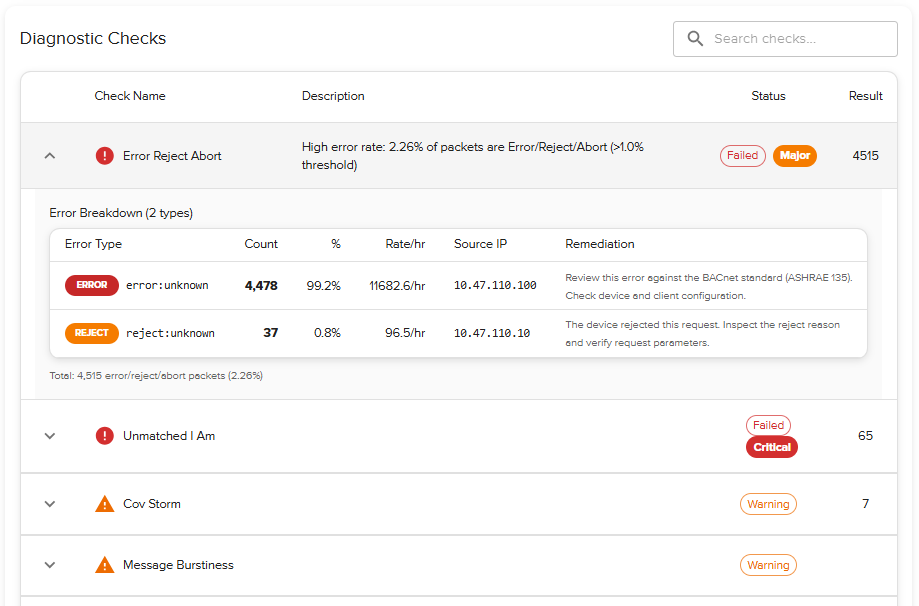
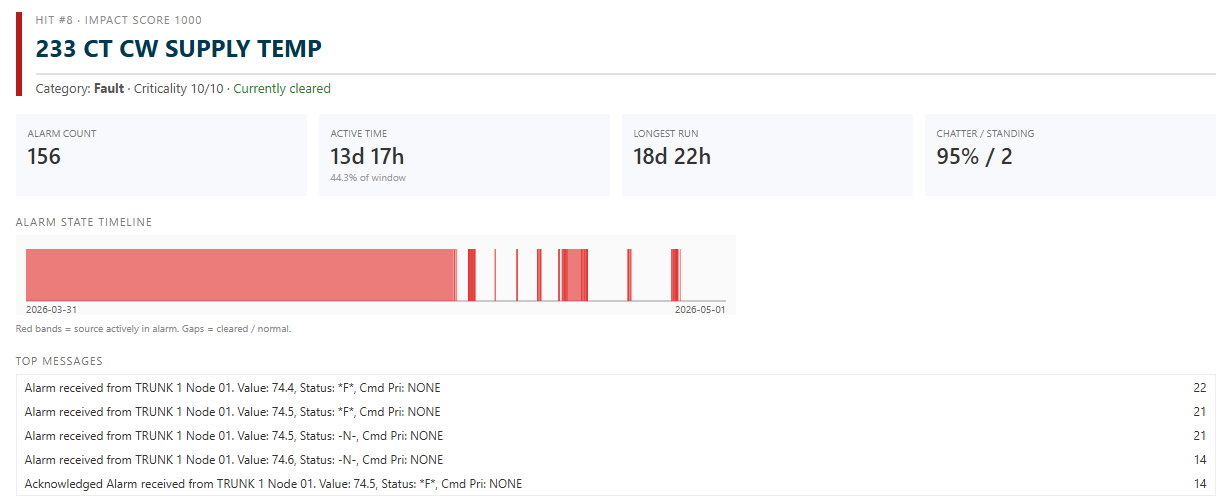
When a single chiller goes down, your operators see thirty downstream alarms across AHUs, VAVs, and zones. Signal RCA collapses the cascade into one root event so the technician fixes the cause not forty symptoms.
Four signals combine to identify the root cause of any alarm cluster.
Topology
Asset topology.
Signal knows which AHUs feed which zones, which chillers feed which AHUs, which feeders power which switchgear. Causes propagate up; symptoms propagate down.
Time
Temporal correlation.
Events within a propagation window get bundled. The first event in the cascade is usually the cause but Signal also weighs criticality and topology, not just timestamp.
ML
Causal scoring.
A learned model ranks candidate causes by historical co-occurrence patterns. The chiller that fails on Tuesday and triggers AHU alarms gets credit fast.
Output
Single ticket.
Forty alarms become one work order against one asset with the right runbook attached. Technicians fix the cause; the symptoms clear themselves.
03 / In Practice
The network view.
Live topology graph showing detected propagation paths. Nodes color by health. Edges show feed-through dependencies. Click any alarm cluster to see the inferred root and the supporting evidence.
On-premise by default. Cloud-deployable when required. Your facility data never leaves your network.
TLS everywhere, secrets in vault, row-level security on every query. Containerized and isolated so one service going down never takes the rest with it.
A·IQ is built by Arcis FM, a Service-Disabled Veteran-Owned Small Business (SDVOSB). Set-aside eligible for federal contracts. CAGE 14DG6 · UEI Z95MQL2KEYG3.
Engineer and operator questions on this capability.
01
Does RCA require us to model topology?
It accelerates accuracy if you do, but Signal can also infer topology from BAS naming conventions, BACnet hierarchy, and historical co-occurrence patterns.
02
How does RCA differ from RCA in process industries?
Same statistical foundations, applied to building systems. The propagation windows are tighter (seconds-minutes), the asset count higher, and the topology more graph-like than tree-like.
03
Can we override the inferred root?
Yes. Operators can promote, demote, or split events. Every override trains the model.
04
Does this require ML?
The default library is rules-based and works without ML. The ML layer adds confidence scoring and pattern learning over time.
07 / Related
Pair with these.
RCA tells you which asset to dispatch on. The rest of Signal tells you what is happening to it.